PASSIONATELY CURIOUS

  • Home
  • About
  • Blog
    • Recent Posts
  • Resources
    • Lessons by Topic >
      • Motion
      • Forces
      • Energy
      • Momentum
      • Circular Motion
      • Waves
      • Electricity
      • Atomic Physics
      • Astrophysics
      • Periodic Table
      • Bonding
      • Chemical Reactions
      • Nature of Science
      • Engineering
    • Collections >
      • Demonstrations
      • Mystery and Breakout Tasks
      • Team Building
      • Mystery Pixel Art
      • Google Form Walk Arounds
      • Design Problems
      • Microsoft Excel
      • Online/Hybrid Lessons
    • Posters
    • 3D Printed Kits >
      • Ionic Bonding Puzzle
      • Radioactive Dice
      • Tangram Square Challenge
      • Tangential Velocity Launcher
      • Double Slit - Physical Model
      • Button Battery LED Holder
      • Resonator
      • Cup Balance
      • Penny Circles
    • Teaching Strategies
    • Sessions and Speeches
    • Just For Fun >
      • Science Memes
      • Science Songs
      • Top Tweets
  • Notes
    • Science Skills
    • Forces
    • Motion
    • Projectiles
    • Force Fields
    • Circular Motion
    • Energy
    • Wave Resonance
    • Electricity
    • Thermal Physics
    • Atomic Physics
    • Energy Production
    • Astrophysics
  • IB Physics
    • Units
    • Content Guides
    • Notes
    • Review Guides
    • IA Resources
    • Test Review
    • Study Guide
  • Store
  • Contact Me
  • Home
  • About
  • Blog
    • Recent Posts
  • Resources
    • Lessons by Topic >
      • Motion
      • Forces
      • Energy
      • Momentum
      • Circular Motion
      • Waves
      • Electricity
      • Atomic Physics
      • Astrophysics
      • Periodic Table
      • Bonding
      • Chemical Reactions
      • Nature of Science
      • Engineering
    • Collections >
      • Demonstrations
      • Mystery and Breakout Tasks
      • Team Building
      • Mystery Pixel Art
      • Google Form Walk Arounds
      • Design Problems
      • Microsoft Excel
      • Online/Hybrid Lessons
    • Posters
    • 3D Printed Kits >
      • Ionic Bonding Puzzle
      • Radioactive Dice
      • Tangram Square Challenge
      • Tangential Velocity Launcher
      • Double Slit - Physical Model
      • Button Battery LED Holder
      • Resonator
      • Cup Balance
      • Penny Circles
    • Teaching Strategies
    • Sessions and Speeches
    • Just For Fun >
      • Science Memes
      • Science Songs
      • Top Tweets
  • Notes
    • Science Skills
    • Forces
    • Motion
    • Projectiles
    • Force Fields
    • Circular Motion
    • Energy
    • Wave Resonance
    • Electricity
    • Thermal Physics
    • Atomic Physics
    • Energy Production
    • Astrophysics
  • IB Physics
    • Units
    • Content Guides
    • Notes
    • Review Guides
    • IA Resources
    • Test Review
    • Study Guide
  • Store
  • Contact Me

Blog

Beats by ______ | Project Based Learning

11/10/2015

Comments

 
Picture
One of my favorite labs to emphasize testing and controlling variables is the classic pendulum experiment. Typically this is framed in a procedure prompting students to perform trials where they change one variable about the pendulum set up and collect data about how the frequency of the swing is affected. This is repeated for the mass of the bob, the string length, and the pull back amplitude. It's a surprising conclusion for many that only the length of the string affects the frequency but the numbers don't lie. 
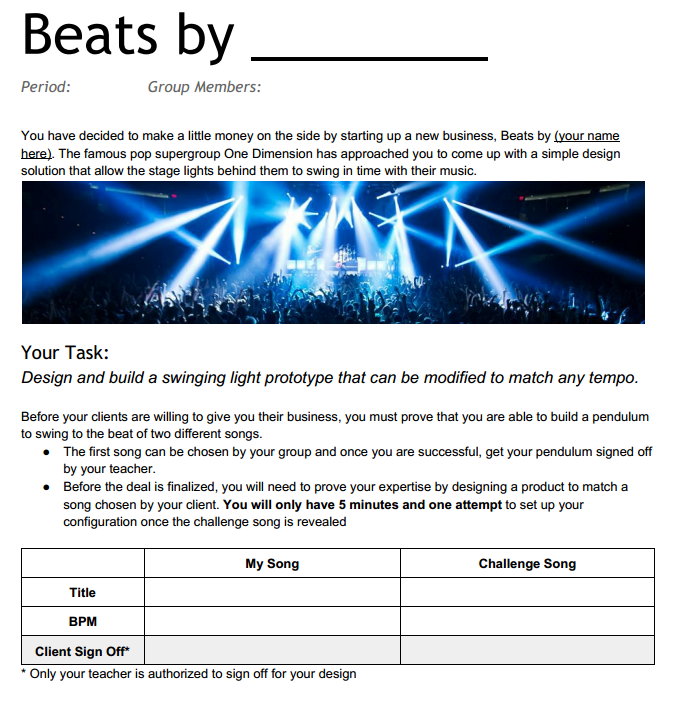
This year, in my quest to projectify my class, I redesigned this lab around a single task: Design and build a swinging light prototype that can be modified to match any tempo. Of course, there is a whole backstory of the students acting as a design firm prototyping some swinging stage lights for a famous pop group, but that is just there to provide some context and motivation to the task.  

With this task, it's all up to the students  to design an experiment to test the different variables, collect data, and model the system. The requirements document to the right includes an engineering design process that helps groups frame their thinking. The framework included some suggested checkpoints but the procedure was all on them. 

Picture
Beats by _______ - Requirements.pdf
File Size: 202 kb
File Type: pdf
Download File

Beats by ___ - Requirements - Google Doc

I didn't give any procedures for today's pendulum project. It took more time, but the learning felt different. Deeper. #PBLchat #Teach180

— Joe Cossette (@cossettej) September 30, 2015
The work time that I gave them in class was really fun to watch. Many groups ended up developing a very similar procedure to the one that we used to give them. The difference was that this was their procedure, not mine. They were experimenting because they decided that experimenting was important.
There is no question that the process took longer with this approach but for the depth of learning that I witnessed in this process, I'm willing to make that sacrifice.​​
Overall, we probably spent close to 4-5 partial days working on the prototypes before they were asked to demonstrate their effectiveness and accomplishing the task. In this time, they needed to figure out away to collect enough data to model their system (either graphically or mathematically) so that they would have something to guide their design during the demonstration.

The Challenge

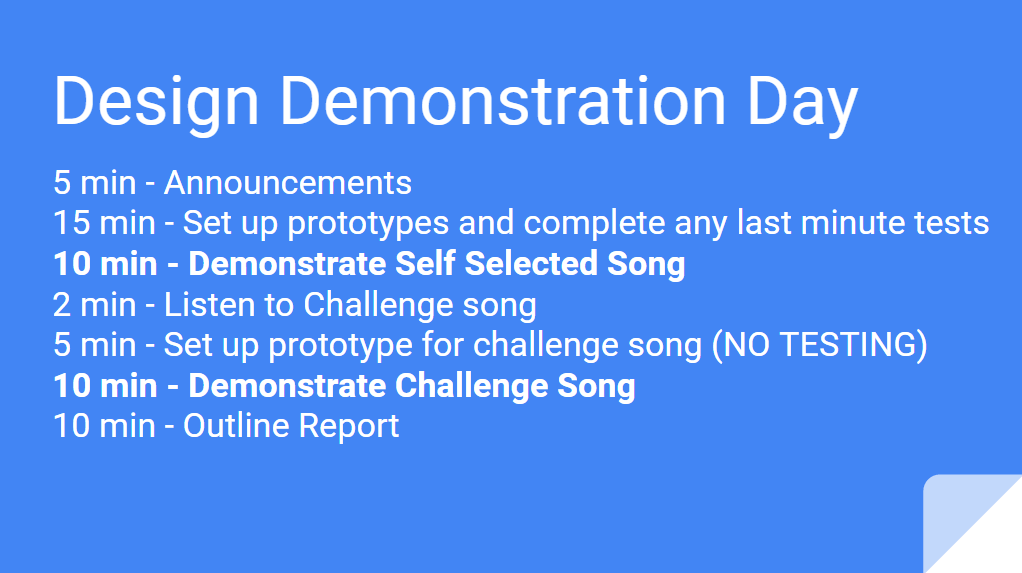
On Demonstration Day, students were given 15 minutes to set up their pendulum prototypes and complete any last minute tests.

Round 1:
After the 15 minutes, each group had to demonstrate that their pendulum could accurately swing to the beat of the song of their choice. 

Round 2:
After all groups demonstrated their first song, I played about 30 seconds of a challenge song that had a different tempo than any of self-selected songs. (see the list of challenge songs on the right) I didn't tell them the BPM of this song so groups needed to use an online metronome to tap out a custom tempo. Each group was given exactly 5 minutes from this point to use their data to set up their pendulums. There was absolutely no testing allowed during this time period. This eliminated the possibility of trial and error. They HAD to use the data that they calculated.
Picture

#Day21: can you create a mathematical model to make your pendulum swing to the beat of any song? #PBLchat #Teach180 pic.twitter.com/vlq3o9AHC6

— Joe Cossette (@cossettej) October 6, 2015

Challenge Songs

80 BPM  -  Heaven  -  O.A.R.
86 BPM  -  Bye, Bye, Bye  -  N*SYNC
95 BPM  -  Good Life  -  One Republic
99 BPM  -  I Want it That Way  -  Backstreet Boys
125 BPM - September  -  Earth, Wind, and Fire

Rubric

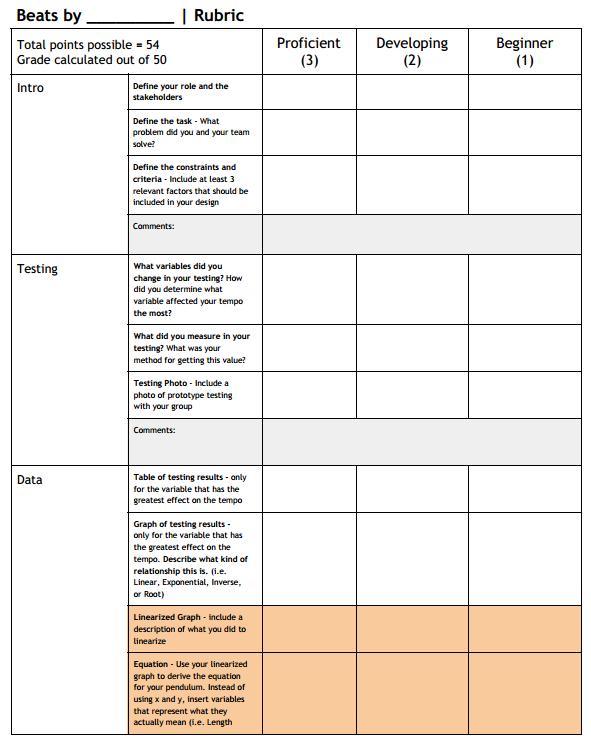
To give students a little guidance and structure in their reports, I provided them with a detailed 18-item rubric outlining my expectation. For each line item, I awarded students a 3, 2, or 1 based on how well they embodied the provided description.

As an extension during this unit, we did a mini lesson about using Microsoft Excel to linearize data and derive an equation to model the pendulum system. Typically, a pendulum system is modeled as a relationship between period and length but in this application, period is a less useful figure to calculate for. Instead, many groups graphed BPM vs length. This relationship is an inverse root curve so they needed to figure out to raise the length value to the -0.5 power, a huge challenge.

To factor in this extension, the rubric was intentionally designed to be out of a possible 54 points (even though it was graded out of 50). This acknowledges the challenge of the linearization and allows students to score above 100% if they take on the challenge.
Picture
Beats by _______ - Rubric.pdf
File Size: 82 kb
File Type: pdf
Download File

Beats by ______ - Rubric - Google Doc

Example Reports

Example Report 1.pdf
File Size: 539 kb
File Type: pdf
Download File

Example Report 2.pdf
File Size: 422 kb
File Type: pdf
Download File

Example Report 3.pdf
File Size: 321 kb
File Type: pdf
Download File


Reflection

Overall I was very happy with the results of this project. I felt that it truly challenged the thinking of many of my students and it led to some really interesting conversations about the hows and whys of setting up experiments within different groups.

I also asked for feedback from students about what they thought about the project itself. The results were split many students liked the challenge and open-endedness of the project but that also caused a great deal of anxiety for some. There is also a disconnect where students still don't see projects as a way of learning. I hope to be more explicit with the learning targets that I hope to hit in the next project.
"Not having a lot of instruction built my independence and confidence."
"I liked it at first it seemed hard but then became really interesting as I figured it out"
"Really challenging, but it really made us think"
"It was unnecessary and time consuming. We could learn the same amount of material in less time for each unit without a project."
"I was frustrated that you didn't tell us which variable to test. it made the whole process much less concrete which makes it harder for me to learn well"

Files

Beats by ______ | Requirements | Google Doc
Beats by ______ - Requirements.pdf
File Size: 202 kb
File Type: pdf
Download File

Beats by ______ | Rubric | Google Doc
Beats by _______ - Rubric.pdf
File Size: 82 kb
File Type: pdf
Download File

Comments
comments powered by Disqus

    RSS Feed

    Picture

    Joe Cossette

    Father, Physics Teacher, Knowles Fellow, Friend, Techie, and Musician

    "Learning to teach teaches me to learn"


    Blog Posts

    • Finding a Habitable Exoplanet
    • Mechanics Super Problem
    • Binding Energy per Nucleon
    • Group Assessment
    • Newton's Law Blocks
    • Plotting the Stars
    • Periodic Aliens
    • Paper Rockets
    • Electronic Holiday Cards​
    • MCwordle Review
    • Bonding Sticker Practice
    • Kiss the Egg​
    • Friction Mini Labs
    • Free Fall Mini Labs
    • Energy Scramble
    • Cryptography Murder Mystery
    • Virtual Circuit Escape Room
    • Internal Resistance Lab
    • Electricity Mini Labs
    • AAPT Presentation
    • When Pigs Fly...
    • Light Mini Labs
    • Sound Mini Labs
    • Mechanics Lab Practical
    • Momentum Mini Labs
    • Energy Mini Labs
    • Mail Merge Assessments
    • Virtual Motion Matchmakers
    • Virtual Motion Escape Room
    • Motion Graph Scavenger Hunt
    • ​The Game of Science
    • Inquiry Cube - "Level Unknown"
    • Inquiry Cubes
    • Sound Wave Interference
    • Circuits Breakout
    • ​Chemical Reactions Crime Scene
    • Bonding Breakout
    • The Missing Piece
    • Groupwork Identity
    • Cup Stack Challenge
    • The Floating Balloon
    • Stop Motion Face Off
    • Motion Graphs Practice
    • Google Form Scavenger Hunt
    • Motion Graph Matchmakers
    • Printable Periodic Table
    • Circuits Scavenger Hunt
    • Energy Scavenger Hunt
    • 1000/24/7 Lectures
    • Up-Goer Five Reports
    • Actionable Norms
    • Writing a Breakout Task
    • Excel on the iPad
    • Excel: Solving with Formulas
    • Excel: Graphing from Data
    • Graphing Lab Data
    • Excel Skills Assessment
    • Energy Breakout​
    • Physics Content Guides
    • Build your own Breakout Kits
    • Building by Design
    • Engineering Communication
    • Google Doc Scavenger Hunt
    • Reflecting on Identity
    • Kinematics Crime Scene
    • Message to the Graduating Class
    • Projectile Murder Mystery
    • Beats by __________
    • The Uncertainty Game Show
    • Data Validation in Google Forms
    • Podcasts
    • Inquiry Cubes

Powered by Create your own unique website with customizable templates.