PASSIONATELY CURIOUS

  • Home
  • About
  • Blog
    • Recent Posts
  • Resources
    • Lessons by Topic >
      • Motion
      • Forces
      • Energy
      • Momentum
      • Circular Motion
      • Waves
      • Electricity
      • Atomic Physics
      • Astrophysics
      • Periodic Table
      • Bonding
      • Chemical Reactions
      • Nature of Science
      • Engineering
    • Collections >
      • Demonstrations
      • Mystery and Breakout Tasks
      • Team Building
      • Mystery Pixel Art
      • Google Form Walk Arounds
      • Design Problems
      • Microsoft Excel
      • Online/Hybrid Lessons
    • Posters
    • 3D Printed Kits >
      • Ionic Bonding Puzzle
      • Radioactive Dice
      • Tangram Square Challenge
      • Tangential Velocity Launcher
      • Double Slit - Physical Model
      • Hair Diffraction Laser Mount
      • Button Battery LED Holder
      • Resonator
      • Cup Balance
      • Penny Circles
    • Teaching Strategies
    • Sessions and Speeches
    • Just For Fun >
      • Science Memes
      • Science Songs
      • Top Tweets
  • Notes
    • Science Skills
    • Forces
    • Motion
    • Projectiles
    • Force Fields
    • Circular Motion
    • Energy
    • Wave Resonance
    • Wave Interactions
    • Electricity
    • Thermal Physics
    • Atomic Physics
    • Astrophysics
  • IB Physics
    • Units
    • Content Guides
    • Notes
    • Review Guides
    • IA Resources
    • Test Review
    • Study Guide
  • Store
  • Contact Me
  • Home
  • About
  • Blog
    • Recent Posts
  • Resources
    • Lessons by Topic >
      • Motion
      • Forces
      • Energy
      • Momentum
      • Circular Motion
      • Waves
      • Electricity
      • Atomic Physics
      • Astrophysics
      • Periodic Table
      • Bonding
      • Chemical Reactions
      • Nature of Science
      • Engineering
    • Collections >
      • Demonstrations
      • Mystery and Breakout Tasks
      • Team Building
      • Mystery Pixel Art
      • Google Form Walk Arounds
      • Design Problems
      • Microsoft Excel
      • Online/Hybrid Lessons
    • Posters
    • 3D Printed Kits >
      • Ionic Bonding Puzzle
      • Radioactive Dice
      • Tangram Square Challenge
      • Tangential Velocity Launcher
      • Double Slit - Physical Model
      • Hair Diffraction Laser Mount
      • Button Battery LED Holder
      • Resonator
      • Cup Balance
      • Penny Circles
    • Teaching Strategies
    • Sessions and Speeches
    • Just For Fun >
      • Science Memes
      • Science Songs
      • Top Tweets
  • Notes
    • Science Skills
    • Forces
    • Motion
    • Projectiles
    • Force Fields
    • Circular Motion
    • Energy
    • Wave Resonance
    • Wave Interactions
    • Electricity
    • Thermal Physics
    • Atomic Physics
    • Astrophysics
  • IB Physics
    • Units
    • Content Guides
    • Notes
    • Review Guides
    • IA Resources
    • Test Review
    • Study Guide
  • Store
  • Contact Me

Blog

Measuring the Speed of Sound

7/3/2022

Comments

 
This is the video that I made during the online COVID year with all of the measurements provided. The description below details how I do this live with my classes on a "normal year" :)

The Premise

There are some amazingly precise ways to measure the speed of sound using cell phone sensors or tuning forks and harmonics, but I feel strongly that all students need the opportunity to experience the speed of sound from a low tech visual/auditory delay. Typically, I find that most students have only really experienced this delay before during thunderstorms and even then, it's not quite the same because most have never been close enough to a bolt of lightning to see and hear it simultaneously.

"The Clapper"

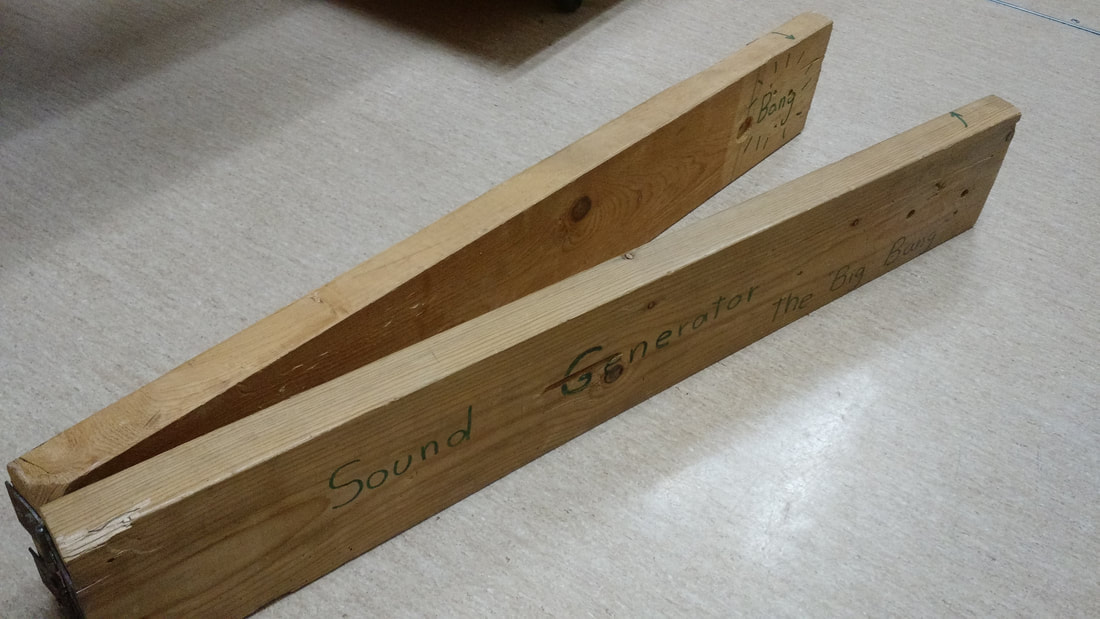
For this to work, you need to be able to make a loud sound that also has a clear visual cue. My sound of choice is a "clapper" built out of a couple of pieces of scrap wood connected together with a hinge
Picture

Measuring Distance

When I do this with my classes, we go out into the parking lot where there is a long straight away so that the students can stand on the one end with their stopwatches and I can stand on the other other end up by the soccer fields with the clapper while still being in their line of sight.
Since this is a distance too long for measuring tape, we would either a trundle wheel or to pace it off to get an approximate distance by measuring directly. To save some time and have an excuse to play around with a new toy, we opt to use a google maps tool instead. :) On google maps, you can zoom in on the satellite image and right click to "measure distance" and draw a line right on the map. (if you need assistance, this Google Maps Help has more info). We just take note of where we were standing and place our line accordingly.
Picture
Measuring our distance at Minnetonka High School (click photo to enlarge)

Measuring Time

Once you have a distance, all you need is a time to calculate the speed of sound using the equation v = d/t.
Even at a very large distance like the one shown in the map above, the time delay between the visual and auditory signals will most likely be less than a second. At this scale, one would naturally expect that the reaction time of the timers would be too large relative to the measurement to get any useful data but we can use a trick to help us out! :)
Once everyone is in position, I stand in my spot with the clapper raised above my head in a "V" formation. This is the signal the students to get their stopwatches ready. Then, without warning, the I clap the boards together as fast as I can. (it is very important not to forecast the timing at all with "warm up claps" or anything else that would help them to anticipate the event)  The timers will see the boards come together followed by a delayed sound of the boards clapping. Timers should start their stopwatch as soon as they see the boards clap together and stop it as soon as they hear the boards clap together. Using this method, if the visual of the boards clapping together is random and unexpected, the reaction times to start and stop the timer should offset and give fairly good results. Basically, they will be equally late in registering that they saw the clap as they will be in registering that they heard the clap but the duration of time on the timer should be the close to the actual time that they were trying for.

Calculating Speed

I usually run through this clapping sequence 5-6 times so that the students have the opportunity to get 3 solid trials in. They then average these times and plug it into v = d/t along with the distance we measured together. The values aren't usually right on the money but they are usually in the 300-400 m/s range which is pretty good considering the crude nature of the experiment. In the video at the top of this post, I got ahold of a camera with a 50X zoom and was able to get some more precise time values than I was timing it in the moment but the purpose of this lab/demo is more about the experience than the result anyway so I wouldn't worry about getting too fancy.

CLICK HERE FOR MORE DEMOS


​Click for more Waves resources ​⬇

Picture
Comments
comments powered by Disqus

    RSS Feed

    Picture

    Joe Cossette

    Father, Physics Teacher, Knowles Fellow, Friend, Techie, and Musician

    "Learning to teach teaches me to learn"


    Blog Posts

    • Finding a Habitable Exoplanet
    • Mechanics Super Problem
    • Binding Energy per Nucleon
    • Group Assessment
    • Newton's Law Blocks
    • Plotting the Stars
    • Periodic Aliens
    • Paper Rockets
    • Electronic Holiday Cards​
    • MCwordle Review
    • Bonding Sticker Practice
    • Kiss the Egg​
    • Friction Mini Labs
    • Free Fall Mini Labs
    • Energy Scramble
    • Cryptography Murder Mystery
    • Virtual Circuit Escape Room
    • Internal Resistance Lab
    • Electricity Mini Labs
    • AAPT Presentation
    • When Pigs Fly...
    • Light Mini Labs
    • Sound Mini Labs
    • Mechanics Lab Practical
    • Momentum Mini Labs
    • Energy Mini Labs
    • Mail Merge Assessments
    • Virtual Motion Matchmakers
    • Virtual Motion Escape Room
    • Motion Graph Scavenger Hunt
    • ​The Game of Science
    • Inquiry Cube - "Level Unknown"
    • Inquiry Cubes
    • Sound Wave Interference
    • Circuits Breakout
    • ​Chemical Reactions Crime Scene
    • Bonding Breakout
    • The Missing Piece
    • Groupwork Identity
    • Cup Stack Challenge
    • The Floating Balloon
    • Stop Motion Face Off
    • Motion Graphs Practice
    • Google Form Scavenger Hunt
    • Motion Graph Matchmakers
    • Printable Periodic Table
    • Circuits Scavenger Hunt
    • Energy Scavenger Hunt
    • 1000/24/7 Lectures
    • Up-Goer Five Reports
    • Actionable Norms
    • Writing a Breakout Task
    • Excel on the iPad
    • Excel: Solving with Formulas
    • Excel: Graphing from Data
    • Graphing Lab Data
    • Excel Skills Assessment
    • Energy Breakout​
    • Physics Content Guides
    • Build your own Breakout Kits
    • Building by Design
    • Engineering Communication
    • Google Doc Scavenger Hunt
    • Reflecting on Identity
    • Kinematics Crime Scene
    • Message to the Graduating Class
    • Projectile Murder Mystery
    • Beats by __________
    • The Uncertainty Game Show
    • Data Validation in Google Forms
    • Podcasts
    • Inquiry Cubes

Powered by Create your own unique website with customizable templates.